Construction Intelligence
San Diego committee advances Midway Rising housing and arena deal
San Diego’s Land Use and Housing Committee advanced the Midway Rising deal October 16. The housing, arena and infrastructure plan awaits full Council consideration.

San Diego committee advances Midway Rising housing and arena deal
City of San Diego | October 20, 2026
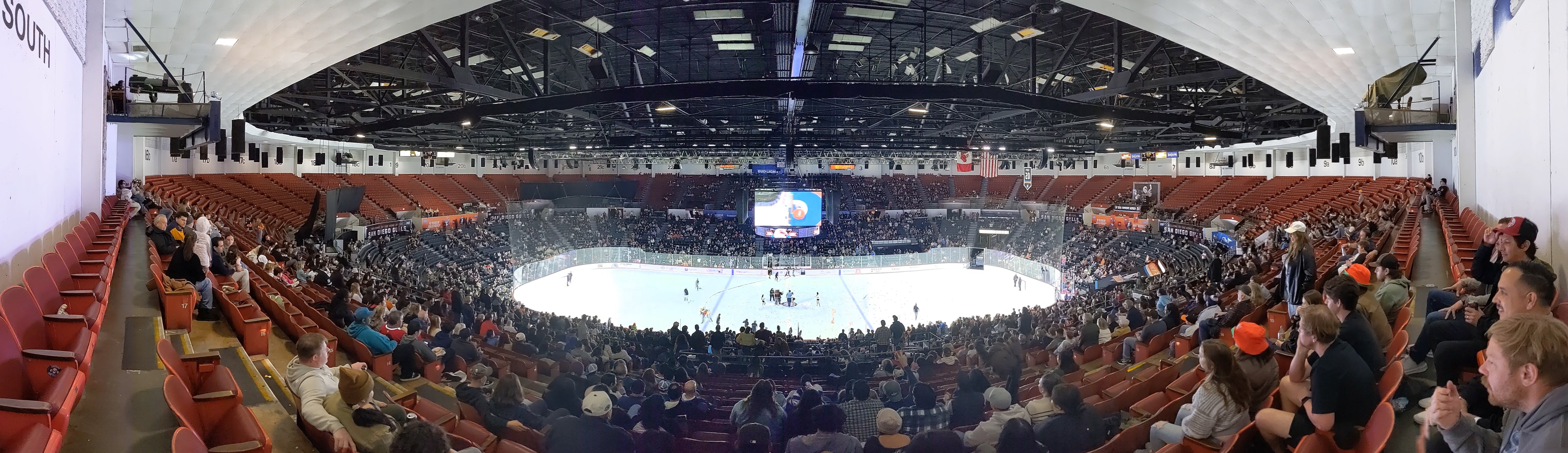
Interior of the existing Pechanga Arena in hockey configuration, January 2, 2026. Context photo; it does not depict the proposed Midway Rising arena. Photo: Pink Floyd Fan 101, Pechanga Arena Panorama.jpg, via Wikimedia Commons, CC BY 4.0. Uncropped; display size reduced.
San Diego’s Land Use and Housing Committee unanimously advanced the proposed Midway Rising redevelopment agreement on October 16. The plan would transform the City’s 48.5-acre Sports Arena property into a neighborhood with more than 4,000 homes, a new arena, shops and public spaces. The documents set out the financing and construction obligations behind the redevelopment.
The committee also advanced plans to form an Enhanced Infrastructure Financing District. The City released details October 12 and now expects full Council consideration in early November.
A neighborhood around a replacement arena
The current City project page lists at least 2,000 affordable homes, including at least 200 permanent supportive housing units, and 2,254 market-rate homes. The arena would contain at least 380,000 square feet with about 16,000 seats; proposed terms permit a reduction to 15,200.
The plan also includes up to 130,000 square feet of retail and commercial space, 8.2 acres of parks and 6.42 acres of public space. According to the City, the existing Pechanga Arena would remain open while its replacement is built.
In the City’s account of the meeting, committee chair Kent Lee emphasized preventing the project from simply serving as an affordable-housing receiver site.
Who is behind the redevelopment
Midway Rising identifies Chelsea Investment Corporation as its affordable-housing developer, Legends as its sports-venue developer, Zephyr as its market-rate housing developer and The Kroenke Group as its real-estate investment partner. Those roles describe the development partnership; they do not establish new construction-contract awards.
Infrastructure comes before buildings
The October 16 staff report puts estimated construction cost at approximately $4.2 billion. A sitewide ground lease would cover infrastructure, followed by separate leases for building parcels. The initial infrastructure lease cannot close until conditions including permits and financing are satisfied. The report describes three infrastructure phases and a performance schedule still to be negotiated.
The proposed terms apply prevailing-wage law and require project labor agreements. For contractors, that makes labor requirements and the split between enabling infrastructure and vertical construction important parts of evaluating the work. Civil, utility and building firms will need phase-specific documents before translating the overall vision into an estimate. These records do not establish an open bid or mobilization date.
Private funding has a public-finance component
The developer would initially fund infrastructure, but a proposed financing district could reimburse eligible costs from future property-tax growth. The Independent Budget Analyst cites an infrastructure estimate of roughly $460 million based on a September 2024 assessment. It should not be mistaken for a newly priced construction package.
The analyst considers the proposed transaction reasonable overall while identifying financial, construction and market risks. Its review anticipates a buildout of roughly two decades. The City would retain the land, but its long-term commitment and the dedication of future tax revenue carry opportunity costs. An absence of upfront City construction payments therefore does not mean the transaction uses no public resources.
A decision point after earlier delays
The staff report says an October 2025 appellate ruling on the district’s height-limit ballot measure delayed earlier Council consideration. On September 29, Mayor Todd Gloria announced the signing of SB 344 and SB 958, describing them as providing greater certainty while preserving environmental review. That statement does not establish that every legal issue is resolved.
Full Council consideration is the next decision point, rather than a construction authorization. Financing decisions and conditions attached to individual leases remain consequential. The newly released documents give residents and the construction industry a clearer account of how the promised neighborhood could be delivered, and what still has to happen first.
Explore related records: San Diego project and permit guide. Product access is required for project search; coverage is partial.
Sources
- City announcement, October 12 — Release, hearing sequence and existing-arena continuity.
- City Sports Arena redevelopment page — Scope checked October 20; its prospective October 16 hearing text is superseded by the post-hearing City announcement.
- City staff report, October 16 — Printed pp. 3–8: prior delay, cost, lease conditions, phasing and labor terms.
- Independent Budget Analyst Report 26-24, October 12 — Printed pp. 1–6: financing, estimate vintage, opportunity costs and risks.
- Midway Rising development team — Undated primary developer page; roles checked October 16.
- Mayor’s legislation statement, September 29 — Signing announcement and City’s characterization; no independent legal conclusion.
- Pechanga Arena Panorama.jpg — photo source — Pink Floyd Fan 101; photographed 2026-01-02; CC BY 4.0.
- CC BY 4.0 — photograph license — Attribution and license conditions apply to this photograph.
- City of San Diego post-hearing announcement, October 16, checked October 20: committee advancement, affordable-housing concern, and expected early-November Council consideration.